The Track That Isn’t There: Rail Access as Unpriced Capital in 2026 US Mine Studies
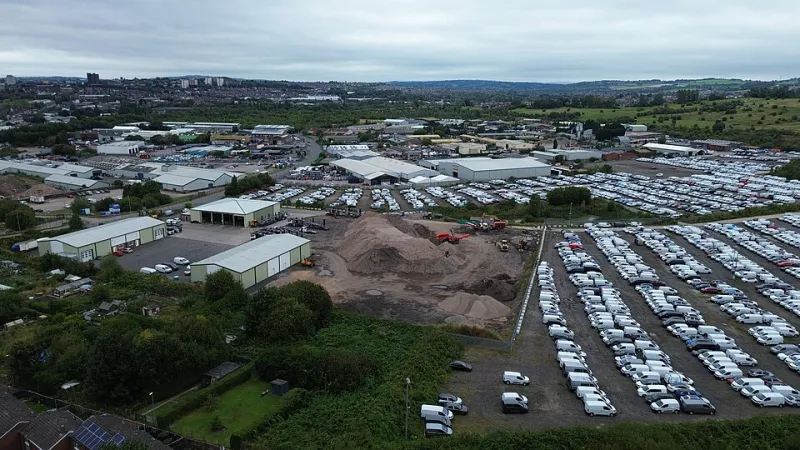
Photo: Gkbediako, CC BY-SA 4.0, via Wikimedia Commons
Every economic study has a boundary, and in most US mining studies published this year that boundary is the mine gate. Beyond the gate sits a line item — transportation — that is usually expressed as a rate per ton and rarely as a capital program. The distinction matters. A freight rate implies a service that someone else provides. A rail spur is a construction project, a permitting exercise, and a commercial negotiation that a junior issuer may have to fund, own, and defend before the first concentrate leaves the property.
For 2026, with capital still selective and feasibility budgets under scrutiny, the question of who builds the last mile has moved from a logistics footnote to a balance-sheet question.
The Assumption That Stops at the Fence
Preliminary economic assessments are permitted to be conceptual, and most exercise that permission at the property line. The mine plan, the recovery circuit, and the sustaining capital receive pages of treatment. Transportation typically receives a sentence, occasionally a table row, and almost never a companion capital estimate.
Two conventions do most of the concealment. The first is the delivered-price assumption, in which the study quotes a netback freight figure sourced from a regional benchmark that may describe a completely different commodity, distance, and car type. The second is the mine-gate convention, in which the product is valued as though a buyer collects it at the fence. Neither is dishonest. Both defer a question that a financier will eventually ask: what does it cost to connect this site to a railroad that will actually serve it?
What a Spur Actually Requires
A greenfield industrial spur is not a length of steel laid on graded ground. It is a civil engineering project with a permitting envelope. Subgrade preparation, ballast, ties, rail, culverts, and drainage are the visible elements. Relocation of utilities, at-grade crossings governed by state and county authorities, and bridge or culvert replacements where the alignment meets water are the elements that move budgets.
Practitioners active in US industrial rail work commonly describe greenfield spur construction in the high single-digit to low double-digit millions of dollars per mile in favorable terrain, with steep grades, wetland crossings, and urban interfaces pushing well beyond that band. For a project fifteen or twenty miles from the nearest mainline, the arithmetic is not a rounding error. It is a capital decision that belongs in the study, not in a footnote about infrastructure.
The Contract Behind the Track
Physical construction is only half the obligation. Access to a Class I railroad is governed by commercial agreements that a junior issuer may be negotiating for the first time, and the terms are not always disclosed in a technical report.
Short-line operators frequently hold the lease on the branch that reaches a project. That introduces a second counterparty, a switching charge, and often a minimum annual commitment. Where the project instead seeks direct service or trackage rights from a Class I carrier, the conversation turns to car supply, unit-train versus manifest economics, rate escalation clauses, and volume thresholds that a single mine may struggle to meet in its early years.
The Surface Transportation Board maintains the common carrier framework, and shippers have recourse through rate and service proceedings. That framework is a backstop, not a business plan. A study cannot assume regulatory relief as an operating condition, and a lender will not underwrite one.
Where the Schedule Bites
Rail is slow in a way that mine construction is not. Alignment surveys, environmental review, right-of-way acquisition across private and public parcels, and coordination with a host railroad’s engineering standards can consume years before the first tie is placed. Construction windows are further constrained by weather and by the railroad’s own capacity to absorb new traffic.
The practical consequence is a gap. A mill may be commissioned before a spur is complete, forcing interim trucking that was never budgeted at scale. Bridge trucking on county roads carries its own constraints — weight limits, road-use agreements, seasonal restrictions, and community tolerance — and each of those constraints has a cost that belongs in the model.
A Due-Diligence Sequence for the Last Mile
Before a project is marketed on a delivered-cost basis, several questions deserve a documented answer.
- Identify the operating railroad, not just the nearest track. Ownership, leaseholder, and serving carrier are frequently three different entities.
- Obtain a written will-serve position. A verbal indication of interest is not a service commitment, and it will not survive an underwriter’s review.
- Measure the real alignment. Distance along a survey corridor, not a straight line, with grades and crossings identified.
- Establish right-of-way control. Confirm which parcels are held, optioned, or still owned by third parties, including any public land segments.
- Scope the permitting path. Environmental review, historic preservation consultation, crossing authorities, and host railroad design standards each carry schedule.
- Model two cases. A rail-connected case and a truck-supported case, with separate capital and operating figures for each, so investors can see what the last mile is worth.
- Check the abandonment record. Existing branch lines in the region may be candidates for discontinuance, which changes the map on a horizon shorter than the mine life.
Reading the Next Study
None of this argues that rail access is unavailable to US projects, or that every spur must be built by the issuer. Third-party transload and short-line solutions are legitimate and often preferable. The argument is narrower: an assumption that someone else will provide the last mile should be evidenced by a contract, a tariff, or a credible third-party plan — not by a benchmark rate carried forward from a different project.
As 2026 economic studies circulate, the useful discipline for readers is to locate the transportation line and ask what stands behind it. Where the answer is a spur, the model should carry the capital. Where the answer is a lease, the model should carry the commitment. Where the answer is silence, the discount applied to the study is not pessimism. It is an accurate reading of the document.